Back To Guides
Buyer Guide // Ecommerce Direct Mail

Best Direct Mail Platforms for Ecommerce Brands (2026)

What is the best direct mail platform for ecommerce brands in 2026? The right answer depends on whether your team needs Shopify-triggered automation, API flexibility, or attribution-first QR tracking that proves what actually worked.

Most ecommerce brands can find a vendor that prints and mails postcards. The harder problem is attribution: tying offline mail back to online behavior, creative versions, customer segments, and revenue so the channel can scale with data instead of guesswork.

By Andrew Fraczak

Audience

DTC ecommerce teams

18 min read

Implementation map

ECOMMERCE: SHOPIFY_SYNC // QR_ATTRIBUTION

Ecommerce platformsShopify triggersAttribution-first QR
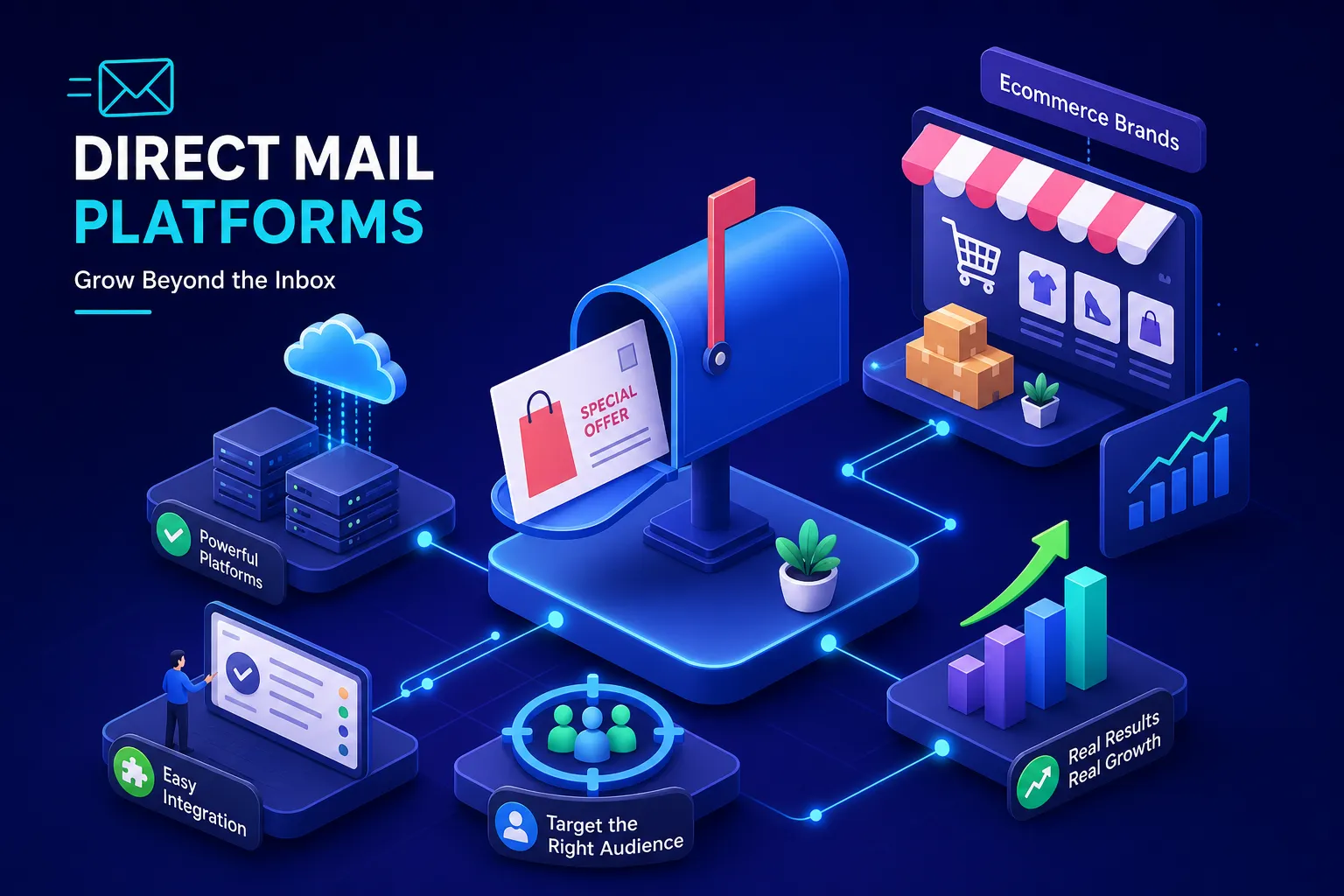
Best direct mail platforms for ecommerce brands in 2026 comparison graphic

Cold list response

2.7-4.4%

Common DMA/ANA direct mail benchmark range cited for prospect-list campaigns.

House list response

5-9%

Owned customer lists often outperform cold prospecting when segmented well.

Pilot focus

Attribution

An attribution-first direct mail pilot should prove response, revenue, CPA, and segment-level differences.

Step 01 // Criteria01

What to look for before choosing a direct mail platform for ecommerce.

Most ecommerce teams start by comparing design templates and per-piece pricing. Those things matter, but they are not what determines ROI. The criteria that separate a useful direct mail platform from a costly experiment are integration depth, personalization capability, and how cleanly the platform ties offline mail to online behavior.

Real Shopify direct mail integration means two-way data sync. The platform should pull purchase history, cart events, and behavioral signals, then trigger mail when a customer meets defined criteria. That is different from a tool that asks the team to upload a CSV every time a campaign runs.

Variable data printing is also table stakes for DTC campaigns. Merge tags such as first name, customer segment, offer, product interest, or loyalty status let one production run carry different messages for different recipients.

Shopify event triggers for abandoned cart, win-back, VIP, and post-purchase flows.

Recipient-level merge tags and variable data support.

Attribution that connects QR scans to campaign, creative, and audience segment.

Per-piece pricing that includes postage, production, platform fees, and data costs.

Step 02 // Market map02

The platforms DTC ecommerce brands rely on today.

No single answer to "what is the best direct mail platform for ecommerce brands" applies to every team. The right fit depends on the stack, volume, audience strategy, and how much attribution detail the team needs.

PostPilot and BirdseyePost are common choices for Shopify-native triggered mail. They can support abandoned carts, win-back timing, VIP segmentation, and subscription or customer milestones without requiring a custom engineering build. BirdseyePost also publishes transparent per-piece pricing and includes QR scan tracking for basic response visibility.

Lob is a developer-first option for teams that want to trigger mail programmatically via API. Postalytics is a self-service option for mid-market teams running scheduled campaigns without much engineering support. Poplar handles abandoned cart and post-purchase postcard automation, while Direct Mail Manager focuses on Shopify-linked repeat sales and milestone campaigns.

PostPilot and BirdseyePost: best fit for Shopify-native triggered mail.

Lob: best fit for API-driven and engineering-backed teams.

Postalytics: best fit for self-service mid-market campaigns.

Poplar and Direct Mail Manager: useful options for Shopify-triggered postcards and loyalty flows.

Step 03 // Cost03

What ecommerce teams realistically pay per campaign.

Direct mail pricing has more variables than most platform pages make obvious. Standard postcards often run $0.55 to $0.90 all-in for addressed campaigns. EDDM saturation mail can drop to $0.30 to $0.55 per piece. Bifold letters often run $0.85 to $1.40, while large flats, self-mailers, and catalogs can land between $1.20 and $2.50.

The biggest cost drivers are volume, format, postage class, personalization, platform fees, address hygiene, data append fees, and design production. These line items matter because a low per-piece quote can become misleading if the pilot also requires monthly platform fees or manual data cleanup.

For a high-AOV ecommerce brand, even a higher per-piece rate can be defensible if the campaign produces strong response and lifetime value. For lower-AOV brands, smaller targeted sends usually make more sense than broad cheap volume. Review SmartSQR Pricing | QR Direct Mail Software when comparing subscription and usage-based planning assumptions.

Budget for postage, print, platform fees, data hygiene, and design production.

Compare cost per response and cost per acquisition, not only cost per piece.

Use small targeted pilots before scaling broad campaign volume.

Step 04 // Attribution04

Where most direct mail platforms leave ecommerce teams exposed.

Brands running direct mail for more than a few months usually hit the same wall: leadership asks which segment, creative, or offer worked, and aggregate reporting cannot answer the question clearly.

Most platforms can generate a campaign QR code and report scan totals. That is a useful starting point, but it does not always show which specific mail piece generated the scan, which audience segment the recipient belonged to, or which creative version they saw. Aggregate scan counts feel like data, but they do not explain what to scale.

Static QR codes add another risk. If the landing page changes after pieces are printed or mailed, the team may be stuck with a broken or outdated destination. Dynamic QR routing solves that by keeping the printed code stable while the destination can be managed after print. For the broader framework, see the Direct Mail QR Attribution Guide | SmartSQR and Direct Mail QR Code Best Practices | SmartSQR.

Ask whether QR scans tie back to campaign, segment, creative, and mail piece.

Avoid judging mature programs only by aggregate scan totals.

Use dynamic QR destinations to reduce landing-page and reprint risk.

Step 05 // SmartSQR05

How SmartSQR closes the attribution loop for DTC teams.

SmartSQR is strongest as an attribution-first ecommerce direct mail layer. It was built around the reporting gap that most direct mail platforms treat as a secondary feature: the QR code is created inside the campaign workflow, not as a standalone static link that has to be reconciled later.

SmartSQR QR codes stay tied to campaign context from design through fulfillment. When audience, creative, or source data exists in the campaign, scan reporting can reflect the drop, list segment, creative, and destination state that produced the action.

SmartSQR also supports editable QR destinations and merge tag personalization in one workflow. That means teams can update landing page URLs after print and keep personalization, QR tracking, design, and campaign context together instead of stitching separate vendors together after launch.

Best fit: attribution-first ecommerce direct mail pilots and repeatable campaign measurement.

Campaign-linked QR codes preserve source context.

Editable destinations reduce reprint risk.

Merge tag personalization keeps audience data connected to the mail piece.

Scan analytics supports segment-level and creative-level ROI analysis.

Step 06 // Roadmap06

What SmartSQR should connect next for ecommerce teams.

SmartSQR's best fit today is attribution-first ecommerce direct mail: create the campaign, keep the printed QR dynamic, and understand which audience, creative, and offer produced scans. The next ecommerce layer should connect that measurement more directly to store data.

The practical roadmap is Shopify customer and order context, customer segment imports, triggered campaign workflows for abandoned cart, win-back, VIP, and post-purchase audiences, and revenue attribution that reports response and ROAS next to scan activity.

Until those native ecommerce triggers are live, teams that need automated Shopify flows should pair SmartSQR tracking with their existing ecommerce direct mail workflow, or choose a Shopify-native platform when automation is the primary requirement.

Shopify customer and order context connected to campaign reporting.

Segment imports that reduce manual CSV work.

Future trigger support for abandoned cart, win-back, VIP, and post-purchase audiences.

Revenue and ROAS reporting layered onto SmartSQR scan analytics.

Step 07 // Pilot07

How to shortlist your platform and run a first ecommerce direct mail pilot.

Three questions filter the shortlist quickly. Do you need Shopify-native event triggers, or is manual segmentation enough? Do you need campaign-level QR attribution, or is aggregate scan data sufficient for now? Are you testing a small batch where measurement matters more than price per card, or printing at enough volume that unit cost is the primary lever?

A 30-day pilot should measure response rate, revenue attributed per mail drop, cost per acquisition compared with a comparable digital channel, and segment-level variation if two lists or offers are being tested.

The segment comparison is usually where the best learning appears. It can show whether a win-back list responds better to a discount, free shipping, loyalty reward, product recommendation, or store-credit offer. That learning compounds into a stronger second campaign.

Define response rate as scans divided by pieces mailed.

Compare revenue and CPA against a digital benchmark.

Test at least one meaningful audience or offer split.

Set attribution infrastructure before the first piece is mailed.

Decision // Recommendation08

The right platform is the one that lets ecommerce teams scale with data.

So what is the best direct mail platform for ecommerce brands? There is no single answer, but there is a clear framework. The best platform is not simply the one with the most templates or the cheapest per-piece price. It is the one that gives the team enough attribution data to scale confidently after the pilot proves out.

PostPilot and BirdseyePost solve the Shopify trigger problem well for teams focused on automation. Lob solves the programmatic API-first problem for engineering-backed growth teams. For DTC teams that need attribution-first QR tracking, editable destinations, and campaign-level proof without reprint risk, SmartSQR fills the gap that many direct mail platforms were not built to address.

Run a tightly scoped pilot, measure it from day one, and scale what the scan data confirms.

FAQ // Ecommerce direct mail09

Frequently asked questions about direct mail platforms for ecommerce brands.

What is the best direct mail platform for ecommerce brands that use Shopify? PostPilot and BirdseyePost are strong options for Shopify-native event-triggered mail covering abandoned carts, win-backs, and VIP flows. For teams that need attribution-first QR tracking on top of ecommerce workflow support, SmartSQR addresses the reporting gap those tools often leave open.

How much does direct mail cost for an ecommerce brand? Standard postcards often run $0.55 to $0.90 all-in for addressed campaigns. EDDM saturation mail can drop to $0.30 to $0.55 per piece. Bifold letters often run $0.85 to $1.40, and large-format mailers can land between $1.20 and $2.50 before platform, address hygiene, or design costs.

What is the difference between static and dynamic QR codes in ecommerce direct mail? Static QR codes lock in the destination URL at print time. Dynamic QR codes let teams update the destination after print, which reduces reprint risk for time-sensitive promotions and landing page tests.

Which direct mail platforms offer campaign-level attribution? Many postcard marketing tools report aggregate scan or campaign-level response. SmartSQR is designed to tie QR scans back to campaign, audience segment, creative version, and destination context so teams can analyze what actually worked.

Next Step // Activation

Choose direct mail software around attribution, not only postage.

Use SmartSQR to create attribution-first ecommerce direct mail campaigns with dynamic QR tracking, merge tags, editable destinations, and source-level analytics.